

What Millennials & Younger Generations are not Understanding about the Investment Opportunity Mining Presents.
Why storytelling is critical to bringing in the next generations of investors into Mining.

Before I dive into theme of the title of this article “What Millennials & Younger Generations are not Understanding about the Investment Opportunity Mining Presents”, understand that I am a millennial who grew up in Montreal Canada where there is little to no mining awareness. With a sector that has been hated for over a decade both as an investment thesis and at a cultural level, mining became beaten up and un-loved. For further context, not only did I attend Concordia’s John Molson School of Business, where I was surrounded by people also interested and passionate about making money, but I spent a lot of my early 20’s reading and watching finance related news. The point I am getting to is that, no where, in any shape or form, was the foundation of a civilization, from infrastructure to monetary cycles ever discussed in any form, whether in school, among friends or on financial news channels.
But as Rick Rule always says, “Love what is hated” - there can be no better of a bottom then a beaten-up, unloved and misunderstood industry - what a great contrarian investment thesis to have concluded in regards to mining and commodities.
To continue my story, I got into the marijuana sector very early—before legalization even looked likely under the incoming Trudeau government. I bought in near the absolute bottom, when it was still just whispers of possibility. I rode the wave up hard, with many positions returning 300–500%. But back then I hadn’t yet learned the single most important lesson in investing: risk management—especially knowing when and why to take profits and having a disciplined exit strategy. Greed drove my decisions instead. I held too long, watching most of those gains evaporate. The timing couldn’t have been worse; the bulk of the damage happened in 2019 and carried into the COVID panic of 2020. It was a brutal, expensive education—but exactly the kind of lesson the market delivers when you need it most.
The point of that little story was to establish, I like and seek out a contrarian thesis. I want to be ahead of the crowd, settle into a thesis and be able to effectively allocated my capital into proper investment opportunities.
Bringing this now back to the theme of the article, why did i get into mining? What drove me 7 years ago into taking my first position in the mining space which has been very profitable to date?
Well, one day I landed up Jay Martin’s CambridgeHouse International youtube channel as it was called back in the day, where I watched for the first time someone I considered to be a great story teller - Gianni Kovacevic, who founded CopperBank Resources, which many of you may now know as Faraday Copper, a top Lundin Investment. The video below is one of the first videos I watched on commodities and immediately I was hooked. Side note, for those who have never been, great conference I have been attending now for the 5th year in a row. Great environment to bridge macro themes and mining investment opportunities. It is now called VRIC - The Vancouver Resources Investment Conference. Hope to see you there next year.
My initial investment of CopperBank was at $0.18 cents when it was worth a few millions in marketcap, and his strategy was simple, buy great assets for pennies on the dollar while copper prices had tanked and become uneconomical for many copper projects. His thesis was strategic, act like a bank, hold these assets until the cycle shifted back into commodities bringing higher copper prices, where he would then hand over the company to a new leadership team who could de-risk the assets to bring them into development. The condition required for this investment to work was higher copper prices. As we stand copper is now sitting over $6 usd/pound, and when i inititally invested in CopperBank, copper was ranging between $2-$3 usd/pound. From $0.18 cents, Faraday now sits around $3.30 as of the date this is being written, with a market cap of $830 million. I sold a portion of the position at $3.0, yielding me a %1700 return on my first ever mining investment, which will potentially become one of USA’s next producing copper mines.
I took profits on a portion of my positions to lock in some gains, securing cash, as markets have become completely unhinged. This included trimming several silver mining stocks that delivered 500% returns. With gold and silver reaching parabolic all-time highs of $5,600 and $122 respectively, I anticipate a near-term pullback. I was in at the bottom, and rode it nearly to the very top we are currently in. Following the latest FOMC decision to hold rates steady, both metals have already corrected sharply. I am now waiting for the mining equities to retreat another 10-20% from current levels. My cash remains on the sidelines, ready to redeploy into this expected volatility when it presents a clear buying opportunity. I believe this opportunity may not be present for very long.
Gianni hooked me when he highlighted a simple but powerful truth: the relentless drive of civilizations and economies to expand, electrify, and grow is fundamentally dependent on a steady supply of commodities. That insight crystallized the investment case for the sector, and I began heavily investing into mining names once i decided to shift my focus from the marijuana sector and into a real macro investment theme. Commodity cycles are cyclical by nature, and after years of dormancy, a powerful upswing felt inevitable. More importantly, the accelerating competition—indeed, the outright race and geopolitical battle—for secure access to critical raw materials was already reigniting.
Patience was the name of the game at first for a younger investor in this space, but that was an opportunity I saw allowing me to take my time and allocate plenty of capital into the sector. The premise was clear: position yourself ahead of the next commodity super-cycle and the intensifying struggle for control over the resources that power modern progress. Eventually governments and main-street would realize that all these tech investments, and desires to electrify economies and bring old underdeveloped economies into the first world will depend on commodities.
Commodities are after all the building blocks of civilization, and we have forgotten that fundamental truth. Nothing can be built without securing supply of these primary inputs.
For over a decade, the mining sector has been largely neglected and under-invested, even as geopolitical chaos has intensified. Nation-states now face mounting pressure to rethink and secure their access to critical metals. Nearly every major economy and continent is enacting mandates to invest in and safeguard supply chains for these essential commodities.
China remains the dominant producer of many strategic metals, while countries like the United States and much of Europe long outsourced these vital initiatives to foreign suppliers. Today, both the U.S. and the European Union are racing to rebuild domestic and allied supply chains. Tariff wars, renewed trade tensions under Trump, and persistent uncertainty have made self-reliance non-negotiable. Nations that fail to act aggressively risk permanent dependence on foreign powers—including potential adversaries—for the metals that power modern economies, defense, and the energy transition. They are all mere dreams if they do not have metals to make it happen.
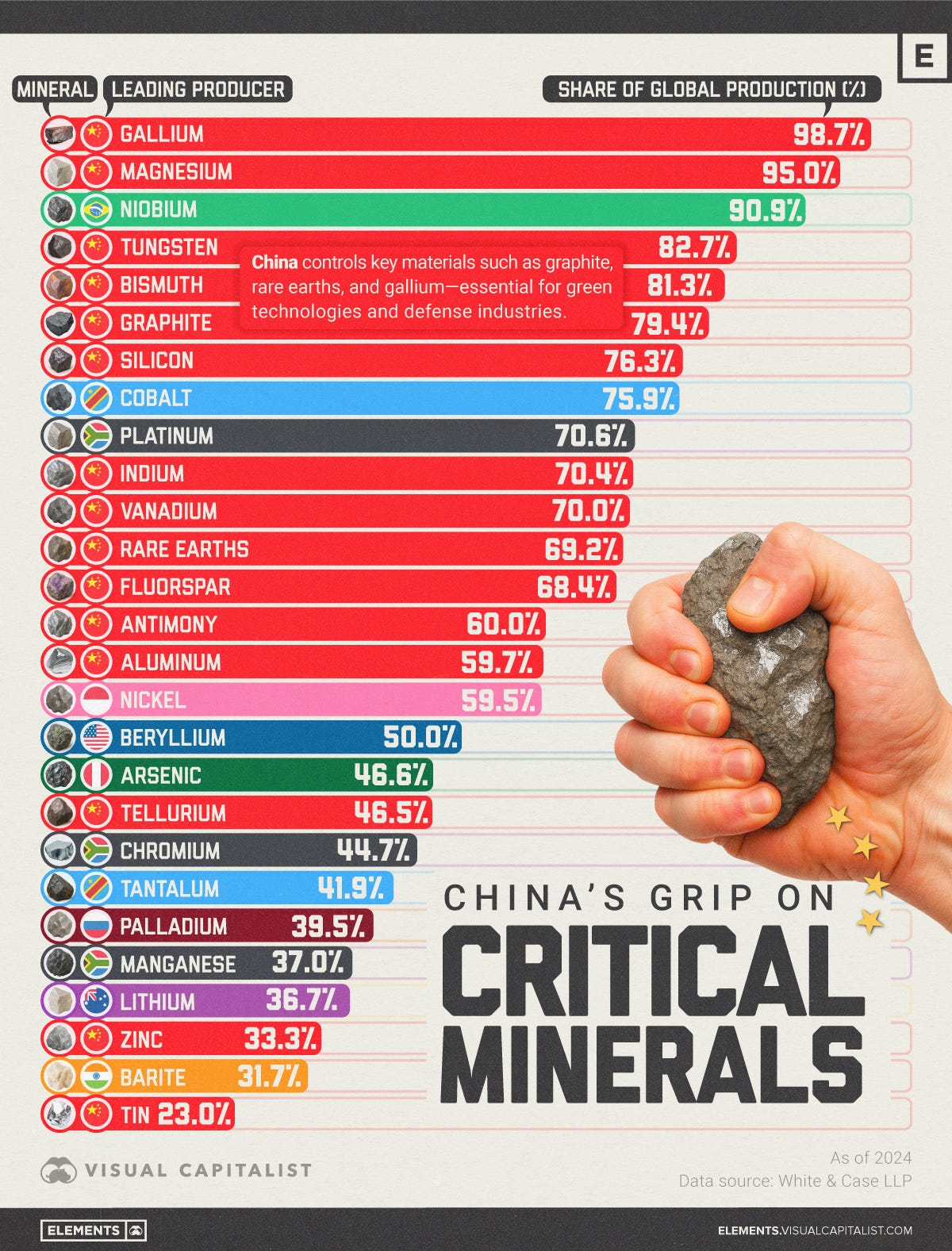
This sector remains heavily uninvested, and unloved, even after the wild first year of returns from this sector. The West is in a race to mitigate the dominance the East has established on critical minerals. The cycle has just begun. Other variables to consider for this investment thesis is:
Major institutions have yet to establish mandates to invest in this space, as many in the financial sector have little to no understanding of how to invest in this sector, beyond simply buying the big producer names like Newmont or Barrick or Rio. Wall street cannot get confident and aggressive in a sector it has neglected for nearly 15 years
Most major mines are seeing their reserves be depleted and companies need to begin adding reserves - M&A has barely scratched the surface.
Very few new mines have been built in over a decade and the demand pressure will be of a whole new magnitude compared to past commodity cycles.
Unlike the last cycle, primarily driven by Asia, this one will be driven by every continent and major economy. The whole world has converged on this problem. A battle over resources will fuel the fundamentals of this cycle.
The money supply is vastly larger than in the last cycle, a lot of money is going to compete over a very limited supply of metals.
Evaluations are still very cheap, especially at current metal prices.
Central banks are hoarding Gold and dumping US dollars. Gold has a larger % in central bank reserves now than the US dollar.
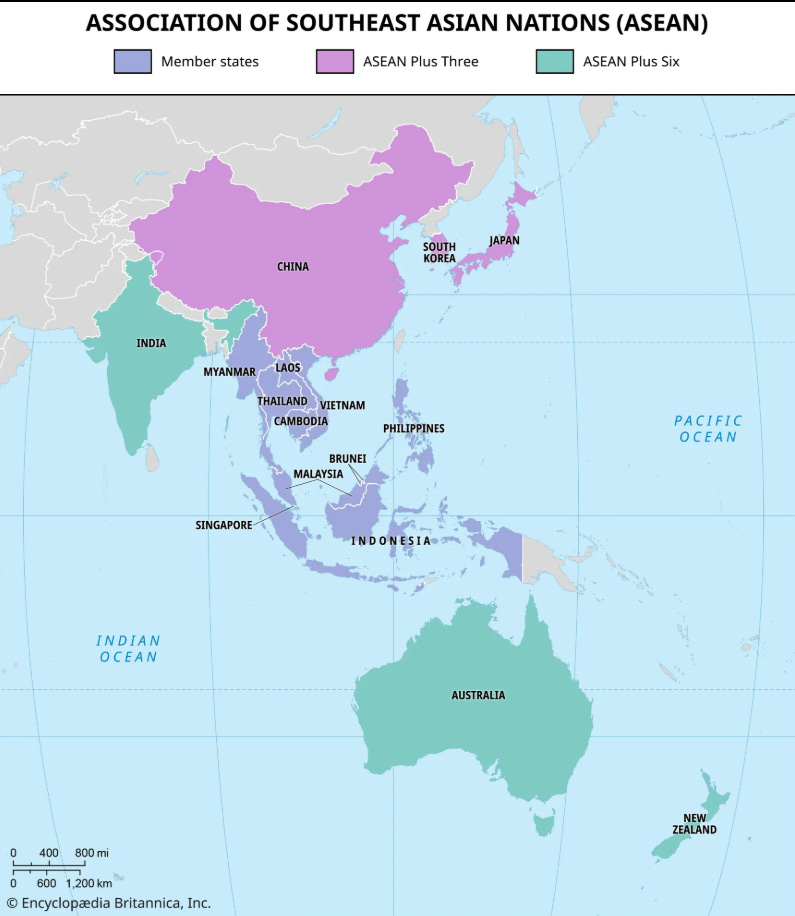
The West is fracturing - not only a East vs West battle, but is now also Europe vs USA. All meanwhile collaboration in the Eastern blocks continue to develop. ASEAN is also growing and working together.
Mining and metals will be at the center of re-industrialization and re-militarization around the world.
Great post, awesome story. The markets have an expensive way of teaching us these lessons. However if we are relentless, don’t give up and live another day to invest, your mindset becomes unshakeably wiser.